
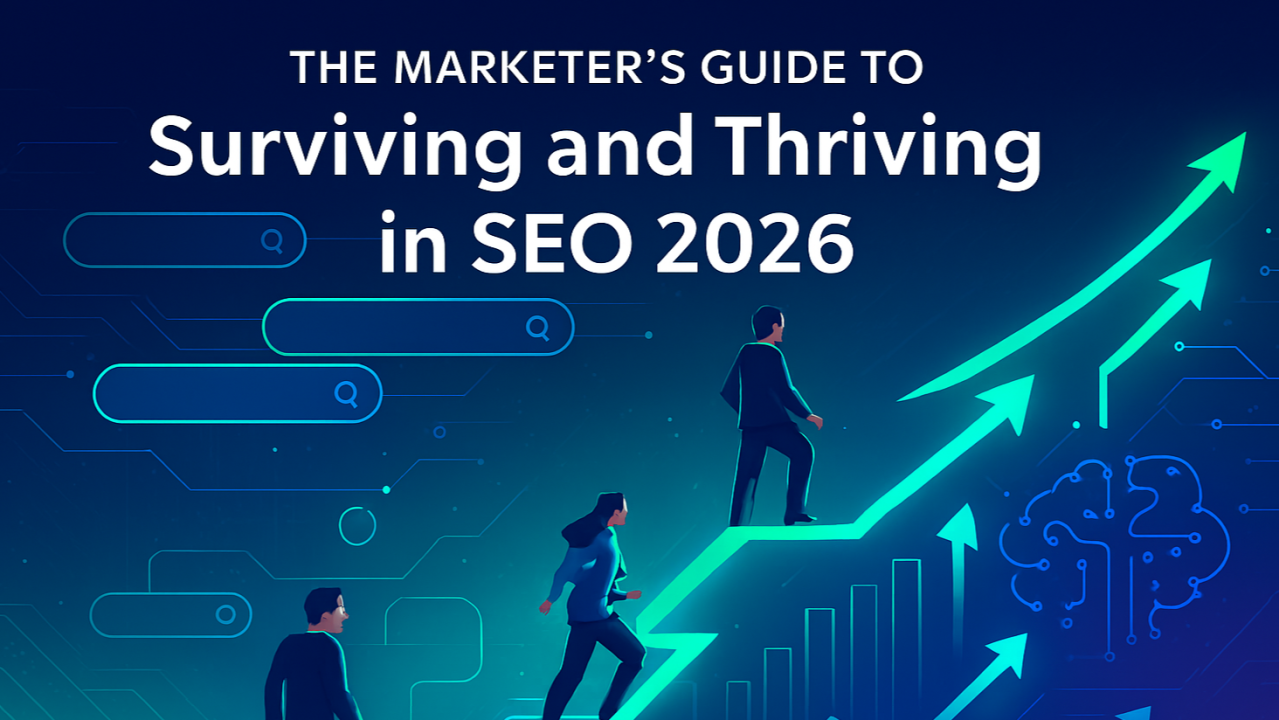
The Marketer's Guide to Surviving and Thriving in SEO 2026
SEO isn't dying. But the way you've been doing it is. The landscape shifted dramatically. Marketers clinging to old tactics are watching their rankings plummet. Meanwhile, those who adapted are seeing traffic growth they didn't think was possible anymore. The difference? They stopped treating SEO as a technical problem and started treating it as a human problem. If you want to not just survive but actually thrive in 2026, you need to understand what's changed and how to respond. Let me walk you through it.
Table of Contents:
The Death of Keyword Stuffing: Welcome to Intent-Based SEO
Expertise Has Become Your Competitive Moat
The Content Game: Quality, Clarity, and Scannability Win
The AI Reality: Your Human Voice Is More Valuable Than Ever
Answer Engine Optimization: The New Ranking Game
Mobile and Voice Search Demand a Conversational Shift
Technical SEO: The Non-Negotiable Foundation
Link Building: Quality Over Quantity, Authority Over Volume
The Marketer's 2026 SEO Survival Checklist
The Real Opportunity in 2026
1. The Death of Keyword Stuffing: Welcome to Intent-Based SEO
Your audience isn't typing keywords anymore. They're having conversations with search engines.
Google's AI now understands context, nuance, and exactly what people need. When someone searches "I keep losing my remote team members," Google knows they're looking for retention strategies, not just pages with those words scattered throughout.
The survival move: Stop obsessing over keywords and start obsessing over solving problems.
How to thrive:
Use Google Search Console to see the actual questions people ask before they come to your site
Create content that answers those questions comprehensively
Address related problems and follow-up questions naturally
Write like you're talking to a colleague, not an algorithm
Check Google Trends to spot emerging questions in your industry
2. Expertise Has Become Your Competitive Moat
Here's what separates the winners from the losers now: genuine authority.
Google's E E A T framework (Experience, Expertise, Authoritativeness, Trustworthiness) isn't a ranking factor anymore. It's the ranking factor. A comprehensive guide written by someone who's never actually done the thing will lose to a 1000-word post by someone who's lived it.
The game has flipped. You can't fake expertise anymore, and frankly, that's good news. It means your real experience is your biggest advantage.
The survival move: Don't try to cover everything. Cover what you actually know.
How to thrive:
Build a visible author brand. Show credentials, experience, and real results
Document your journey. Case studies beat generic advice every single time
Include testimonials and real client outcomes
Be specific about what you've done and what worked
Use Ahrefs or SEMrush to find gaps where your unique perspective gives you an unfair advantage
3. The Content Game: Quality, Clarity, and Scannability Win
Forget what you heard about "long form content." That's not the whole story.
A focused, well-structured 1200-word article with crystal-clear formatting beats a rambling 5000-word essay every single time. People don't read online anymore. They scan. They search for what they need. Then they decide if it's worth their time.
Your job: Make it ridiculously easy for someone to understand your point in under 30 seconds.
The survival move: Stop writing for volume. Start writing for clarity.
How to thrive:
Use specific, benefit-driven subheadings that answer questions
Break content into short paragraphs (2-3 sentences max)
Use numbered lists and bullet points liberally
Add visuals: screenshots, tables, infographics, videos
Lead with your most important insight immediately
Use Yoast SEO to check readability in real time
4. The AI Reality: Your Human Voice Is More Valuable Than Ever
Everyone's using AI now. Which means generic AI-written content has become invisible.
AI is fantastic for research, outlining, brainstorming, and first drafts. It's terrible at replacing your unique perspective. The marketers thriving in 2026 are using AI as a tool, not a crutch.
Generic AI-generated content gets buried. Authentic human insights with AI assistance gets amplified.
The survival move: Use AI to work faster, not to think less.
How to thrive:
Write your core arguments and examples yourself
Use AI to expand points, organize information, and polish language
Add specific data, personal stories, or original research that AI can't provide
Personalize every AI-generated section with your voice and perspective
Do a voice test: Read it aloud. Does it sound like you?
5. Answer Engine Optimization: The New Ranking Game
Google's generative AI is now giving answers directly in search results. This should scare you only if you're not prepared for it.
Here's the opportunity: If you optimize for these AI-generated answers, you become the source Google pulls from. You get the credit. You get the authority. And many people still click through to read the full context.
This is answer engine optimization (AEO), and it's the new frontier.
The survival move: Answer specific questions upfront and format answers for easy scanning.
How to thrive:
Open with a direct answer to the main question
Use clear formatting: numbered lists, tables, short paragraphs
Create comprehensive FAQ sections addressing follow-up questions
Optimize for long-tail, conversational questions
Structure your content as a journey: first question → second question → deeper insights
6. Mobile and Voice Search Demand a Conversational Shift
Your audience searches differently than they did five years ago.
Voice searches are longer, more conversational, and phrased as natural questions. Mobile searches happen on the go, often voice activated. People aren't typing "remote team retention." They're asking, "How do I keep my remote team from leaving?"
This changes everything about how you write.
The survival move: Write like people talk.
How to thrive:
Target long-tail keywords that sound like natural speech
Use conversational language throughout
Optimize for question-based queries ("How to," "What is," "Why should")
Ensure your site loads fast on mobile (test with PageSpeed Insights)
Test on actual mobile devices, not just your computer
If you serve local customers, optimize aggressively for local search
7. Technical SEO: The Non-Negotiable Foundation
Great content on a broken website ranks nowhere.
Core Web Vitals matter. Speed matters. Mobile responsiveness matters. This isn't changing. This is your baseline, not your advantage.
But most competitors are still dropping the ball here. Which means fixing your technical foundation alone can give you a competitive edge.
The survival move: Get the basics right. No excuses.
How to thrive:
Set up Google Search Console and monitor it weekly
Run PageSpeed Insights and fix red flag issues
Optimize images (usually the biggest speed culprit)
Use a Content Delivery Network (CDN) for faster global delivery
Test on real devices and real networks, not just your computer
Fix crawl errors and broken links
Ensure your site is mobile-responsive and easy to navigate
8. Link Building: Quality Over Quantity, Authority Over Volume
The backlink game has completely transformed.
One link from a respected industry authority is worth infinitely more than 100 links from low-quality directories. Google now cares about relevance and the authority of the linking site, not link volume.
This is actually great news. It means you don't have to hustle for thousands of mediocre links. You just need to build relationships with the right people.
The survival move: Stop collecting links and start earning them.
How to thrive:
Create genuinely link-worthy content: original research, useful tools, comprehensive guides
Reach out to industry publications and build real relationships
Find sites linking to competitors and ask why they haven't found you
Focus entirely on earning links from relevant, authoritative sites in your niche
9. The Marketer's 2026 SEO Survival Checklist
If you implement nothing else, implement this:
Know your audience deeply. What problems do they actually have? What language do they use? What stage of the buying journey are they in?
Create expert-backed content. Write about what you actually know. Share real results. Include case studies. Build trust through authenticity.
Optimize for humans first. If the content is clear, useful, and well-formatted for readers, search engines will reward it.
Master the technical fundamentals. Fast loading, mobile responsive, no errors. This is table stakes.
Build real authority. Earn quality links. Build relationships. Establish credibility that can't be faked.
Adapt to modern search behavior. Voice queries, mobile-first, long-tail keywords, conversational language. Write for how people actually search now.
10. The Real Opportunity in 2026
Here's what's actually happening: The algorithm has become so sophisticated that it can only reward what's genuinely valuable.
The tricks are dead. The shortcuts are gone. The only path forward is being real.
This is hard news for marketers who built their careers on gaming the system. It's fantastic news for those who want to build something sustainable.
The marketers thriving in 2026 will be those who:
Stop chasing rankings and start creating value
Build genuine expertise in their niche
Communicate clearly and authentically
Serve their audience better than anyone else
Use data and tools strategically, not tactically
SEO isn't about survival anymore. It's about thriving by doing what you should have been doing all along.
What's your biggest SEO challenge right now?
Is it traffic, rankings, or something else?
Drop your challenge below and let's discuss what's working in your industry.
© 2025-aRa Digital Agency
We offer digital services to help businesses grow sales & build their strong brand presence.
WhatsApp/Call: +91-8374429113
Email ID: contact@aradigitalagency.com